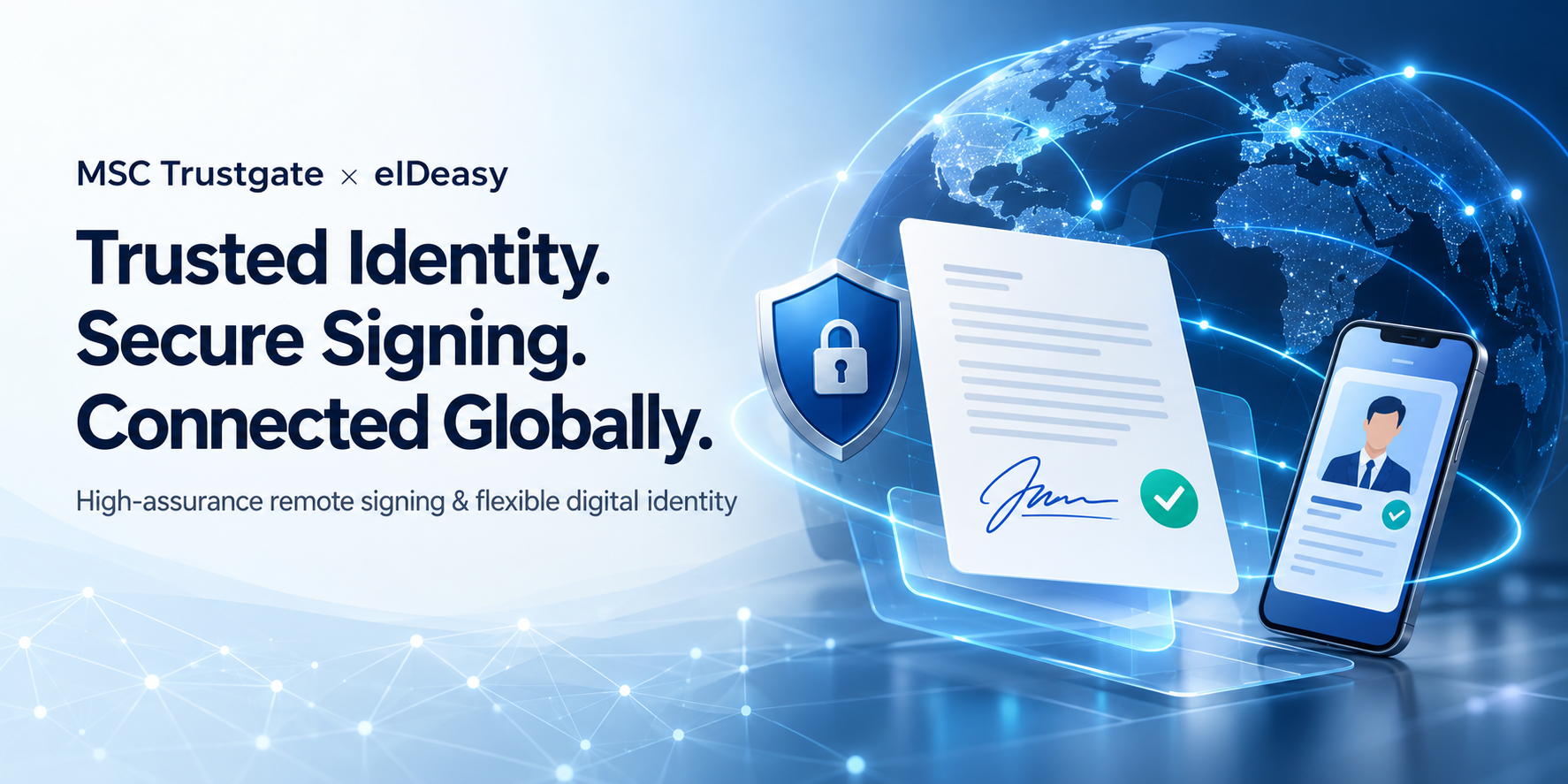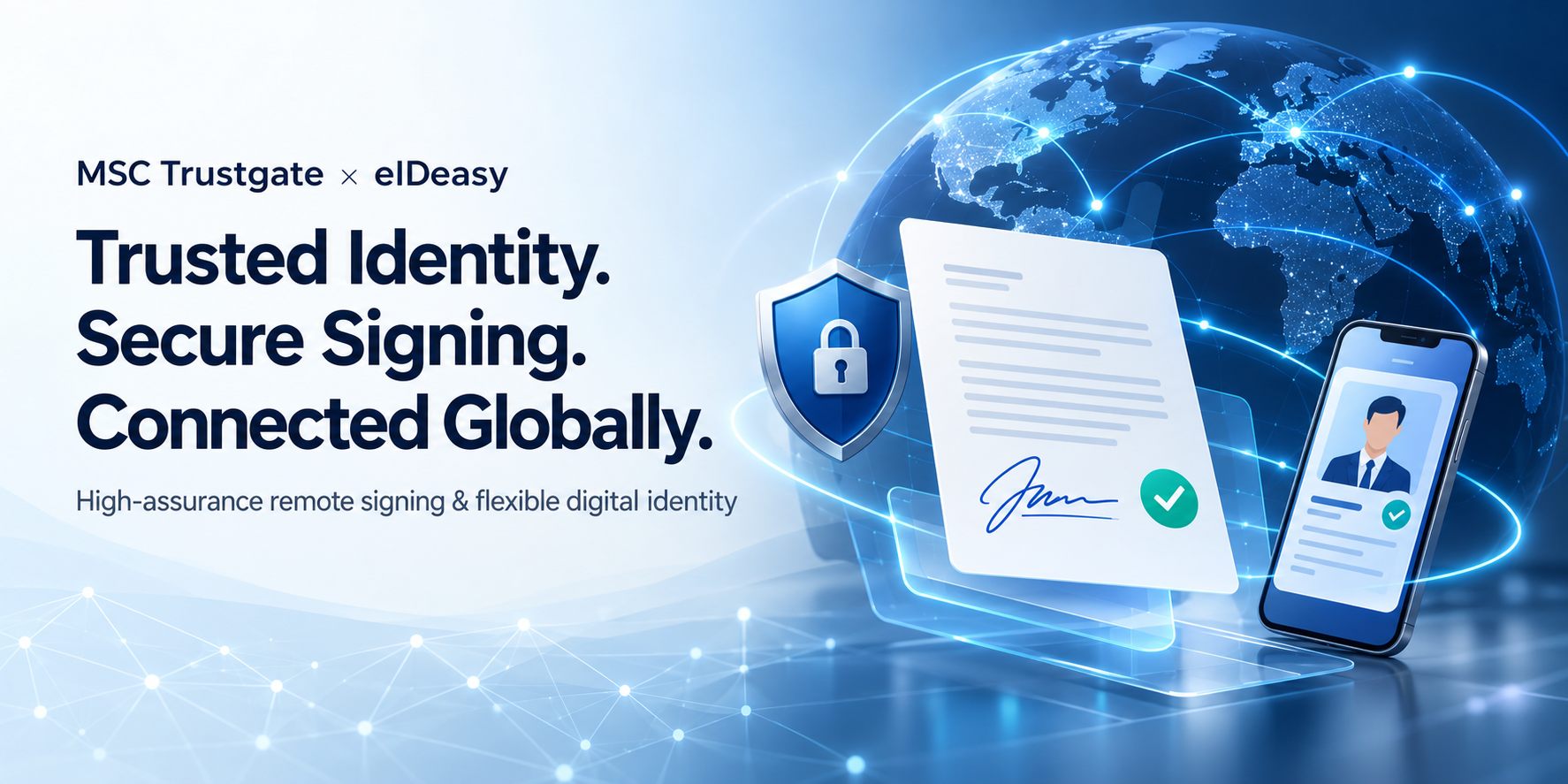
MSC Trustgate Expands Remote Signing and Digital Identity Through eIDeasy
Signing a document online should be simple. Behind that experience, however, organisations need confidence in the signer’s identity, the integrity of the document and the reliability of the digital certificate used. MSC Trustgate addresses these requirements through Public Key Infrastructure (PKI), digital certificates, identity verification and remote-signing services.
Bringing MSC Trustgate’s Remote Signing to eIDeasy
Through a newly signed partnership, eIDeasy customers can connect to MSC Trustgate’s remote-signing solution through eIDeasy’s unified platform using the Cloud Signature Consortium (CSC) API.
This gives platforms and enterprise customers a practical way to add certificate-based remote signing to existing digital workflows. Depending on the implementation, users can complete the required identity-verification and authentication processes before signing documents through a connected journey.
For businesses, the integration can reduce the work required to develop and maintain separate connections with individual signing providers. Instead, organisations can use eIDeasy’s unified integration approach to access MSC Trustgate’s remote-signing capabilities.
The solution also draws on MSC Trustgate’s participation in the Adobe Approved Trust List (AATL). Digital signatures created with valid AATL-backed certificates can be recognised and validated as trusted in Adobe Acrobat and Acrobat Reader, subject to certificate validity, document integrity and the relevant application trust settings.
How the CSC API Supports Remote Signing
The CSC API provides a standardised interface that enables applications to connect with compatible remote-signing services. It helps reduce reliance on proprietary interfaces and simplifies the integration of digital-signing capabilities into applications, portals and document workflows.
The CSC API provides the technical connection to the signing service, while MSC Trustgate’s digital certificates support verification of the signer’s certificate and the integrity of the signed document.
Identity verification and strong authentication remain essential because a trusted signature depends on confidence in the person using the signing credential. The appropriate identity checks, certificate type and signature assurance level should be selected according to the transaction, applicable requirements and intended use.
Connecting Identity Assurance with Digital Signing
A trusted signing journey begins by establishing who is signing. For corporate transactions, organisations may also need to confirm the company represented by the signer and whether that person is authorised to act on its behalf.
MSC Trustgate supports several identity-verification and authentication options:
- MyDigital ID: Supports identity journeys using Malaysia’s national digital identity framework.
- vLEI—Verifiable Legal Entity Identifier: Supports verifiable organisational identity and corporate-role credentials, helping establish the organisation represented by a person and their capacity to act.
- MyTrustID: Provides MSC Trustgate’s eKYC and authentication capabilities for digital onboarding and two-factor authentication.
These options give organisations flexibility when designing their signing processes. An individual signing a personal agreement may require a different identity journey from an authorised representative signing for a company.
Through the integration, customers can explore a suitable combination of identity verification, authentication and CSC API-enabled remote signing. The availability and implementation requirements of each method should be confirmed for every deployment.
Supporting Consumer and Corporate Workflows
Bringing identity assurance and signing into one connected workflow can reduce repeated steps, simplify onboarding and help users’ complete transactions more efficiently. It also gives organisations a clearer basis for establishing who signed a document and confirming whether the document has been altered.
Potential applications include customer agreements, employment documentation, supplier contracts, corporate approvals, financial documents and cross-border commercial transactions. The appropriate signature assurance level and legal requirements will depend on the transaction, industry and jurisdiction. Organisations should evaluate these factors when designing their digital-signing process.
By combining eIDeasy’s unified platform and CSC API connectivity with MSC Trustgate’s PKI, digital certificates, identity capabilities and remote-signing infrastructure, the partnership broadens the options available to organisations developing secure digital services for local and international users.
A Shared Commitment to Digital Trust

Hazhar Ismail, Chief Operating Officer, MSC Trustgate
“At MSC Trustgate, we believe high-assurance digital trust should be simple to integrate and globally recognised. Partnering with eIDeasy allows us to bring our AATL-backed remote signing and flexible identity-verification capabilities—from national digital identities such as MyDigital ID to corporate vLEI credentials—to a broader international ecosystem. Together, we are making secure cross-border signing easier for businesses and end users.”
Explore the Possibilities for Your Organisation
Whether your organisation is introducing remote signing for the first time or expanding an existing digital-document workflow, MSC Trustgate can help identify a suitable combination of CSC API integration, identity verification, authentication and certificate-based remote signing.